

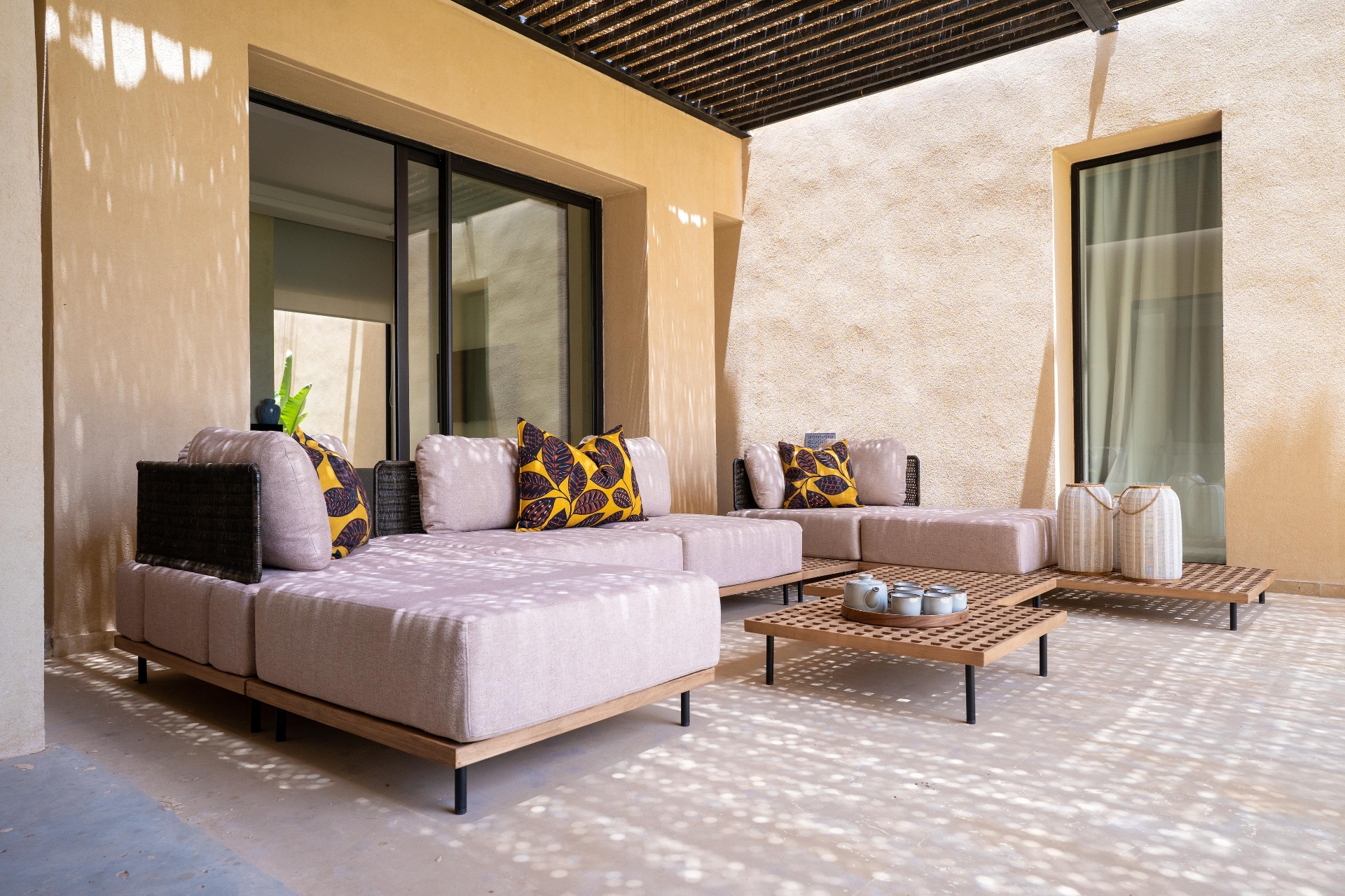
How we lit a 14th-century riad (without ruining the tilework)
Restoration-grade zellige, no drilling, no tape, no gels. A walkthrough of the 3-light setup we used to shoot a 14th-century courtyard — and the small compromises that made it work.

The owner spent 11 years restoring this riad. The zellige in the central courtyard was laid by a master craftsman from Fez. The rule was clear: no drill holes, no gaffer tape on the tilework, no gels that would leave residue. We had one night and three lights. Here is exactly what we did.
The riad is built around a 9m x 6m central courtyard with a fountain in the middle, four orange trees, and the original zellige floor from the 14th century restoration. The walls are hand-tadelakt in two colours. There is one original cedar beam that we were instructed to shoot as if it were a museum piece. The owner is a client of ours, and the second we walked in, we knew this was a shoot we could not mess up.
The 3-light setup
Light 1 was a Profoto B10X bounced off a 1.2m octabox, positioned at the western entrance, simulating the warm late-afternoon sun that would have hit the courtyard 4 hours earlier. Light 2 was an Aputure 600D with a fresnel attachment, mounted on a 4m stand behind the eastern arch, providing a cool rim light on the orange trees. Light 3 was a small Astera tube tucked into the fountain basin, providing the reflection on the water that sells the courtyard in the edit.
- 01Light 1: Profoto B10X + 1.2m octabox, western entrance, 4500K
- 02Light 2: Aputure 600D + fresnel, 4m stand, eastern arch, 6500K
- 03Light 3: Astera Titan tube, fountain basin, 3200K
- 04Camera: Phase One IQ4, 23mm Schneider, f/8, ISO 50, 1/15s
What we did NOT do
We did not drill. We did not tape. We did not put a gel on the tilework. Every light stand had a rubber foot. Every cable was run along the perimeter of the courtyard, not across the floor. We used two MagMod MagGrip clamps on the cedar beam — they were removed at the end of the shoot and inspected by the owner before we left. The 1/15s shutter speed was the maximum we allowed to avoid any motion blur on the water reflection.
“If the owner can't tell you were there, you did it right.”
The result
The deliverable was 24 frames, 6 of which became the listing for the riad. The riad sold in 11 days, 4 days under asking. The owner credited the photography in the thank-you note. We framed one of the prints and gave it to him as a year-end gift. That print is the only marketing image we have ever printed and hung, and it is the most photographed frame we have ever shot.

Lighting a heritage property is about restraint. The biggest mistake is over-lighting — the moment you add a fourth light, the space starts to feel like a set. We have shot 6 restoration-grade riads in the last two years, and the rule is always the same: as few lights as possible, as long as the result holds. If you are quoting a heritage shoot, ask the owner what the off-limits materials are, and respect them.

